
BIM
Consulting
Build the Capability. Not Just the Model.
Capability. The lasting asset.
The most common mistake we see is a firm buying software licences and assigning staff to a BIM project before anyone has agreed what "done well" actually looks like. The tools were never the hard part—aligning people, process and technology around one plan is.
A modeled building is a deliverable. A trained team, a working BIM Execution Plan and a funded adoption roadmap are capabilities—they outlast any single project. Our consulting engagements build that capability inside your organisation: role-based training your staff can apply immediately, ISO 19650-aligned execution plans that hold up under tender scrutiny, and phased adoption roadmaps sized to your budget and risk appetite.
Capability, built to stay.
From first BIM hire to enterprise-wide rollout—every engagement starts with a strategic assessment, not a software order, and is designed to leave capability behind, not just a report. Hover over any service for the full scope.
BIM Adoption
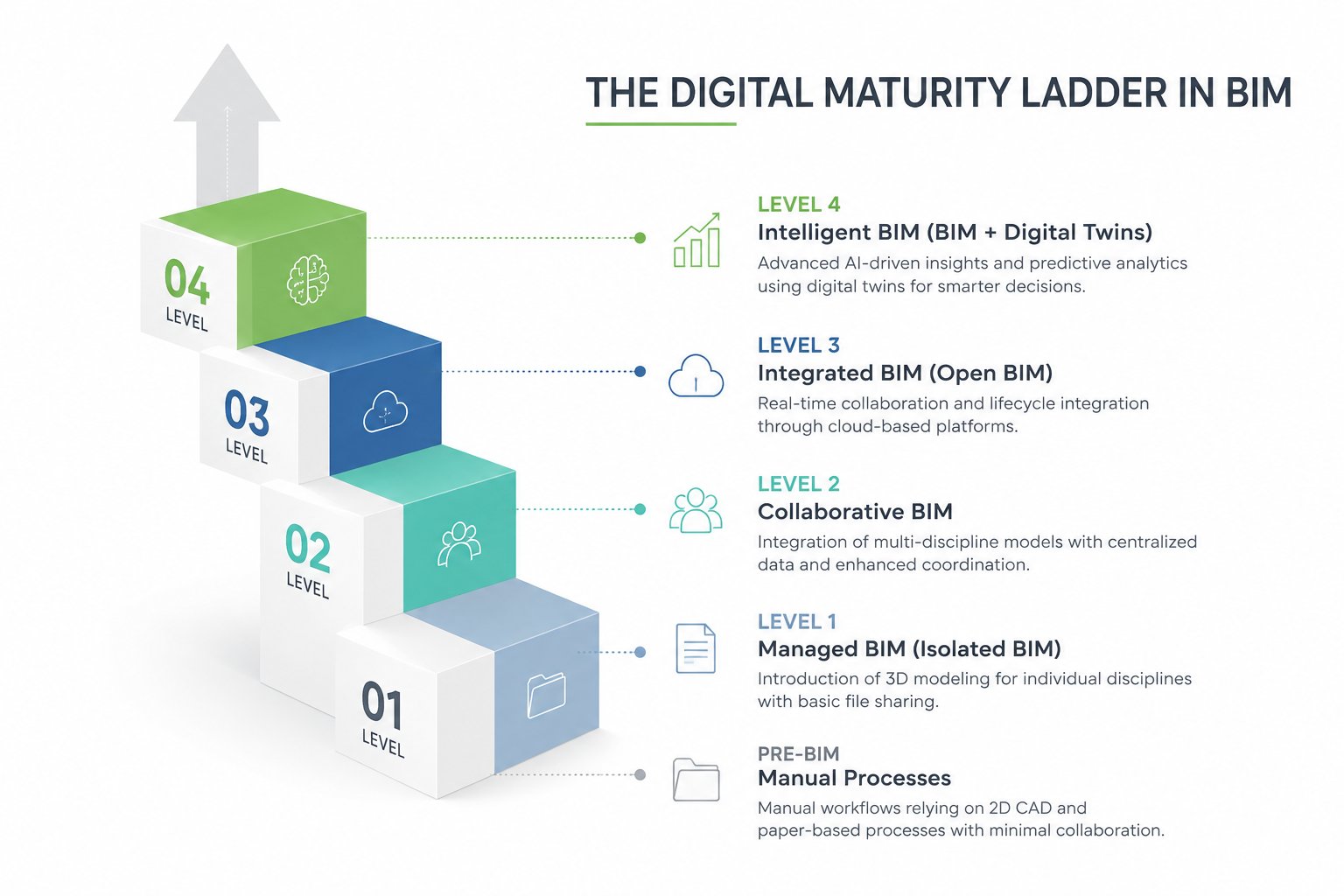
Maturity assessment and a phased, budget-sized roadmap to move from pilot to enterprise-wide BIM.
- BIM maturity assessment (current-state audit)
- Phased adoption roadmap with milestones
- Software & hardware procurement guidance
- Change-management plan and pilot project selection
See the full 5-step Part B process below.

- Industry roadmaps from CII and NICMAR forecast a formal public-sector BIM requirement within 3–5 years
- Fragmented, multi-vendor project teams and resistance to change remain the sector's biggest adoption barriers
- Firms adopting ahead of a mandate protect market position as procurement criteria tighten
BIM Training
Role-based Revit, Navisworks and BEP-authoring training that your team can apply from day one.
- Role-based curriculum: modelers, coordinators, PMs
- Hands-on training on live or pilot project data
- Certification-aligned assessment
- 90-day post-training help-desk support
See the full 5-step Part B process below.
- India needed more than 40,000 skilled BIM professionals in 2025 alone, and demand keeps outpacing supply
- University BIM coursework is uneven in depth and rarely covers Indian rate libraries or CPWD workflows
- In-house training closes the skills gap faster than hiring, which is scarce and expensive
Five steps from assessment to embedded capability.
Typical timeline: assessment to a trained, certified team in 8–14 weeks.
Maturity assessment & goal-setting
We audit where your team stands today and agree, in writing, what “successful adoption” looks like for you.
Roadmap & BEP authoring
We turn the assessment into a phased plan — and, if you need one, a tender-ready BIM Execution Plan.
Pilot project deployment
We put the plan into practice on one real project first, so lessons are cheap and the next rollout is smooth.
Team training & certification
We train your staff, by role, on the exact workflow the pilot just proved out.
Embed & scale
We hand over governance of the process to your team, with ongoing support as you scale beyond the pilot.
This is what makes BIM the way you build, not just a deliverable someone hands you once.
Why leading firms are investing in BIM consulting now.
- 01
Formal public-sector mandate likely within 3–5 years
Early adopters protect market position.CII & NICMAR · industry roadmaps urging a phased national BIM mandate. - 02
40,000+ skilled BIM professional shortfall
Trained talent becomes a competitive asset.EPC World · India's BIM skills gap versus tender demand, 2025. - 03
Level 2 BIM mandated on central housing >₹100cr
Compliance readiness protects eligibility.MoHUA notification, 2019 · collaborative BIM for central government housing. - 04
Level 2 BIM mandated on highways >₹100cr
Highway EPC bidders need it to qualify.NHAI circular, 2021 · collaborative BIM for major highway projects. - 05
BEP now a pre-qualification criterion, not a recommendation
A weak BEP can cost you the tender.CPWD & NHAI tender practice · non-BIM contractors increasingly lose bids. - 06
India BIM market growing at 11% CAGR to $1bn+ by 2034
Demand for BIM-capable firms keeps rising.IMARC Group · India Building Information Modeling Market Overview. - 07
30–40% fewer RFIs with structured adoption
Less site confusion, fewer delays.Industry benchmarks · RFI reduction, material waste and schedule compression from BIM adoption. - 08
15% material waste reduction
Less waste, better margins.Industry benchmarks · measured impact of coordinated, model-based delivery. - 09
ISO 19650 alignment expected on global & govt tenders
One standard, fewer disqualifications.BIS / India BIM Alliance · national alignment with ISO 19650. - 10
Global infrastructure could save 15–25% via BIM
The upside compounds at scale.EU BIM Task Group · projected global infrastructure savings from BIM adoption.
From one-off deliverable
to standing capability.
Anyone can hand you a model. Fewer can leave your team able to run the next one without you. Real BIM adoption isn't a software rollout—it's people, process and technology moving together, on one plan, toward one standard. That's the difference between a service and a capability—and it's the only kind of BIM consulting worth paying for.
We don't consult on BIM. We build your BIM team.




The ten questions we hear most.
- 01
What's the difference between BIM consulting and BIM modeling services?
Modeling delivers a model for one project. Consulting builds your team's ability to plan, author BEPs, and run BIM workflows yourselves — a capability you keep across every future project.
- 02
Do you provide training for our in-house team, or only outsourced modeling?
Both are available, but consulting engagements are specifically about upskilling your own staff — modelers, coordinators and PMs — so you rely less on outsourcing over time.
- 03
What is a BIM Execution Plan (BEP) and do we need one?
A BEP defines scope, LOD, software and responsibilities before modeling starts. Most CPWD, NHAI and metro-rail tenders now require one as a pre-qualification document, not an optional extra.
- 04
How long does a BIM adoption roadmap take to implement?
Assessment and roadmap: 2–4 weeks. Pilot deployment runs alongside a real project. Full team training typically completes within 2–3 months of roadmap sign-off.
- 05
Is BIM mandatory in India yet?
Not universally, but Level 2 BIM is already mandated on central government housing above ₹100cr and NHAI highway projects above ₹100cr, and a broader national mandate is forecast within 3–5 years.
- 06
What software will our team be trained on?
We're software-agnostic — training covers Revit, Navisworks, Tekla, ArchiCAD or Bentley depending on what your team already uses or plans to standardise on.
- 07
Can you help us win tenders that require ISO 19650 or BEP compliance?
Yes — BEP authoring and CDE setup are scoped specifically to meet tender evaluation criteria, not just generic best practice.
- 08
We already have some BIM experience — can you just fill the gaps?
Yes. The maturity assessment identifies exactly what's missing — software gaps, process gaps, or skill gaps — so you only pay for what you actually need.
- 09
What certification do we receive after training?
A certification-aligned assessment mapped to buildingSMART and ISO 19650 competency frameworks, plus a completion record for tender staffing submissions.
- 10
How do you measure BIM adoption success?
Against the goals set in step one — typically RFI reduction, rework avoided, tender pre-qualification pass rate, and staff able to run workflows without external support.
Explore our
other services.
From BIM consulting to material testing, our integrated services cover every phase of project delivery under one accountable, verified partner.
View all services